Oracle · 6 min read
How to Build Oracle Fusion Integrations That Survive Quarterly Updates?
Oracle Fusion Cloud runs on a mandatory quarterly release cycle, and each update comes with some risk to existing integrations. Any type of change can break a previously working process. This could…
Written by Aniket Mittal
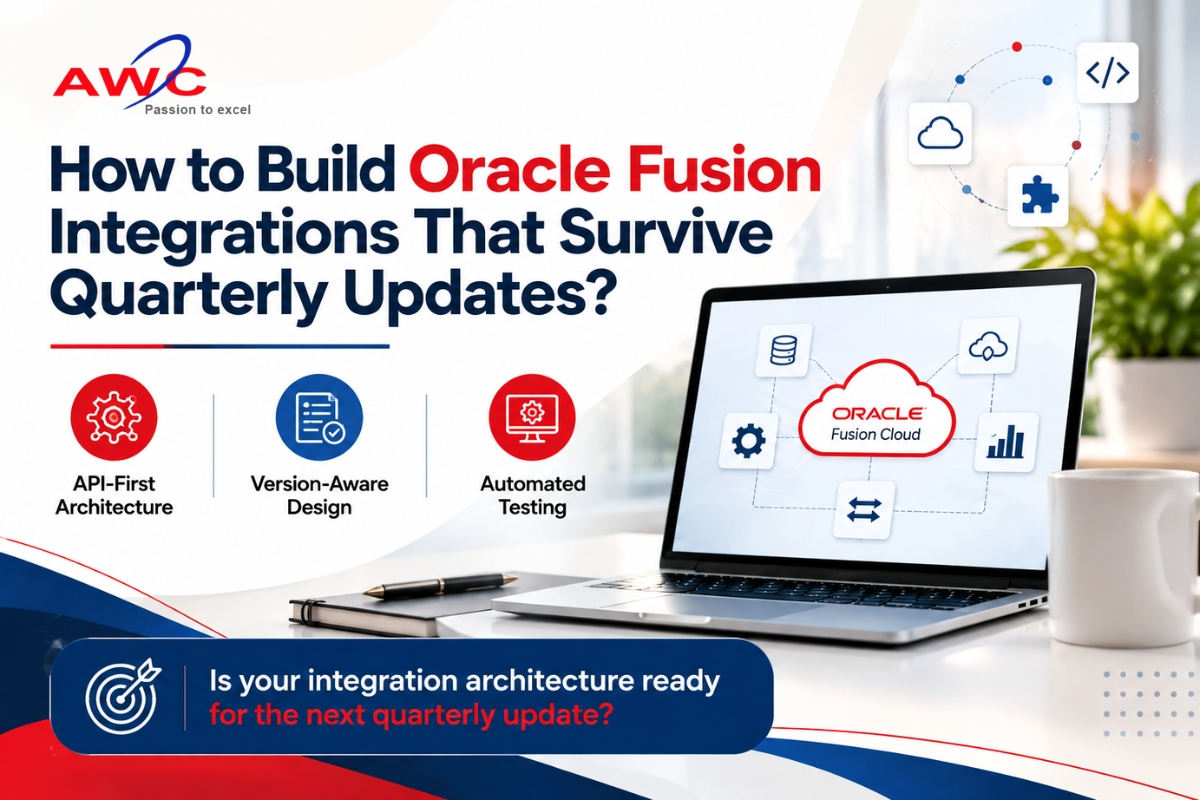
Oracle Fusion Cloud runs on a mandatory quarterly release cycle, and each update comes with some risk to existing integrations. Any type of change can break a previously working process. This could include a shift in WSDL or REST API, a new validation rule to follow, or a new mandatory field added to FBDI template.
The process can stop functioning without a hint to its users. Organizations using Oracle Integration Cloud, SOA composites, or other custom integrations will not have a chance to just accept updates, hence it becomes critical to create integrations that can withstand the change without being affected.
Why Quarterly Updates Break Fusion Integrations?
Oracle's update cadence (typically 24A, 24B, 24C, and so on) pushes new features, patches, and occasional breaking changes to REST/SOAP APIs, Business Events, ESS job parameters, and page layouts simultaneously across all pillars — HCM, ERP, SCM. Because Fusion is a shared multi-tenant SaaS platform, customers can't skip a release. Integrations built without a change-tolerant design often fail because of:
- Deprecated or versioned API endpoints (v1 to v2 migrations)
- Modified payload schemas or mandatory field additions
- Security policy changes affecting OAuth scopes or token expiry
- Business rule updates that alter data validation downstream
Integration Dependency Mapping
Before you can protect an integration, you need to know exactly what it touches. Dependency mapping documents every upstream and downstream component: source APIs, target endpoints, SOA composites, VBCS extensions, OTBI/BIP reports, and any custom PL/SQL or middleware logic in between.
Maintaining this map as a living document is not a one-time diagram. It lets teams quickly identify which integrations are exposed when Oracle publishes its Readiness Report for an upcoming release, so testing effort can be prioritized by blast radius rather than guesswork.
Release Impact Analysis
Oracle publishes Release Readiness documentation roughly a month before each quarterly update goes live in production, following its standard Update 1 → Update 2 → Update 3 environment promotion cycle. A disciplined impact analysis process includes:
- Reviewing "What's New" and "Opt-In" feature lists for every pillar in use
- Cross-referencing changed REST resources against the dependency map
- Flagging any deprecated API versions using Oracle's REST API deprecation notices
- Assigning risk scores (high/medium/low) to each integration based on exposure
This turns release impact analysis from a reactive scramble into a structured, repeatable checklist run every quarter.
Regression Testing That Actually Catches Breakage
Regression testing for Fusion integrations needs to go beyond "does the integration still run." It should validate data accuracy, error handling, and edge-case payloads. Effective regression suites typically include:
- Functional regression — re-running core integration scenarios (new hire load, invoice sync, order fulfillment) against the test/Update environment
- Data validation regression — comparing output payloads field-by-field against baseline snapshots
- Negative testing — deliberately sending malformed or boundary-value payloads to confirm error handling still triggers correctly
Government and industry standards bodies reinforce why structured configuration and change control matter for systems like this. NIST's guidance on configuration management stresses baselining, controlled change assessment, and continuous verification after any system modification — principles directly applicable to Fusion's quarterly release model. You can review the official guidance here: NIST SP 800-128, Guide for Security-Focused Configuration Management of Information Systems.
Test Automation for Fusion Integrations
Manual regression testing every quarter doesn't scale. Automating the process using tools like OIC's built-in testing framework, Selenium for UI-dependent flows, or API-level automation (Postman/Newman, SoapUI) against the Update 2 test environment allows teams to:
- Run the full regression suite unattended before the Update 3 production cutover
- Generate pass/fail reports mapped directly to the dependency map's risk scores
- Catch schema or authentication failures days before go-live, not after
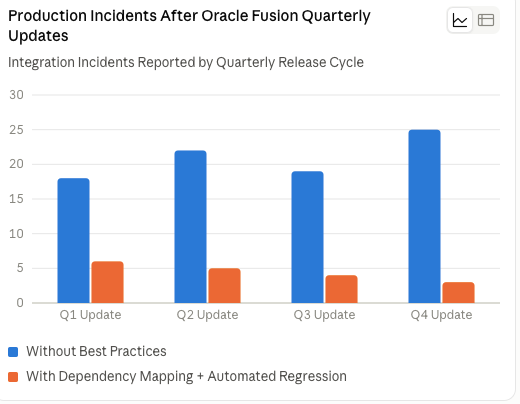
The chart below illustrates the typical impact of combining dependency mapping with automated regression testing — production incidents drop sharply once these practices are institutionalized:
API Lifecycle Management
Fusion REST and SOAP APIs follow their own versioning and deprecation timeline, independent of the quarterly UI changes. Strong API lifecycle management means:
- Tracking API version usage across all integrations in a central register
- Migrating off deprecated endpoints before Oracle's sunset date, not after
- Applying semantic versioning discipline to any custom or wrapper APIs your team maintains
- Enforcing OAuth token refresh and scope validation as part of routine health checks
Custom Integration Monitoring
Once integrations are live, synthetic monitoring and alerting catch issues before end users do. Effective monitoring setups combine:
- OIC's native monitoring dashboards for flow-level success/failure tracking
- Custom alerting (email, Slack, PagerDuty) tied to error thresholds, not just outright failures
- Payload volume and latency tracking to catch silent degradation
- Scheduled synthetic transactions that simulate real integration runs post-update
Reducing Production Issues: A Practical Checklist
To consistently reduce post-update production issues, mature Fusion teams typically:
- Freeze non-critical integration changes during the Oracle patch window
- Run full regression automation against Update 2 before Update 3 promotes to production
- Maintain rollback and error-compensation logic in every integration flow
- Review Oracle's Readiness Reports against the dependency map every single quarter
- Conduct a post-go-live monitoring window (48–72 hours) with heightened alert sensitivity
Frequently Asked Questions
Why do Oracle Fusion quarterly updates break integrations?
Each quarterly update can change REST and SOAP APIs, business events, ESS job parameters and validation rules across HCM, ERP and SCM, and customers can't skip a release. Common causes of failure are deprecated API versions, modified payload schemas or new mandatory fields, changes to OAuth scopes or token expiry, and business rule updates.
How often does Oracle release Fusion Cloud updates?
Oracle Fusion Cloud follows a mandatory quarterly release cycle (for example 24A, 24B, 24C). Oracle publishes Release Readiness documentation roughly a month before each update reaches production, and updates move through an Update 1 → Update 2 → Update 3 environment promotion cycle.
What is integration dependency mapping?
It is a living document of everything an integration touches: source APIs, target endpoints, SOA composites, VBCS extensions, OTBI/BIP reports and any custom PL/SQL or middleware logic. When Oracle publishes its Readiness Report, the map shows which integrations are exposed, so testing can be prioritized by risk.
How should regression testing be done for Fusion integrations?
It should go beyond checking whether the integration still runs. Include functional regression of core scenarios, field-by-field data validation against baseline snapshots, and negative testing with malformed or boundary-value payloads. Automate it with tools such as OIC's testing framework, Postman/Newman or SoapUI against the Update 2 test environment.
How can we reduce production issues after a quarterly update?
Freeze non-critical integration changes during the patch window, and run full regression automation against Update 2 before Update 3 reaches production. Keep rollback and error-compensation logic in every flow, review Readiness Reports against the dependency map every quarter, and monitor closely for 48–72 hours after go-live.
Final Thoughts
Oracle Fusion's quarterly cadence isn't going away, and treating each release as a one-off fire drill leads to recurring outages. Integrations that survive — and keep surviving — are the ones backed by living dependency maps, disciplined release impact analysis, automated regression suites, proactive API lifecycle governance, and continuous monitoring. Build that foundation once, and each quarterly update becomes a routine checklist item instead of a production emergency.
Tags: Oracle Fusion, Integration, OIC, Regression Testing