SAP · 8 min read
SAP Integration Architecture: APIs, Events and SAP Integration Suite vs. Point-to-Point Interfaces
Modern SAP landscapes rarely work alone. Here is how APIs, event-driven architecture and SAP Integration Suite compare with classic point-to-point interfaces, and when to use each.
Written by Aniket Mittal
Modern SAP landscapes rarely work alone. An SAP S/4HANA system often needs to talk to CRM platforms. It may also connect to e-commerce applications, logistics providers, banking systems, data platforms, HR systems, and custom cloud services.
It is not just a question of transferring information from one place to another. The bigger challenge will be to devise an approach that will be safe, flexible, and sustainable as the business expands.
Here is when the ideas of API integration, event-driven architecture, and SDK integration guide come into play since they provide alternatives to classic point-to-point system linking methods.
Why Integration Architecture Matters in SAP?
A big company may host thousands of integration processes. An order made in SAP S/4HANA can go to an e-commerce website that can start warehouse processing, update a CRM system and send notifications to customer apps within minutes. But if all systems talk to each other directly, it soon becomes a mess. This is the classic point-to-point integration dilemma.
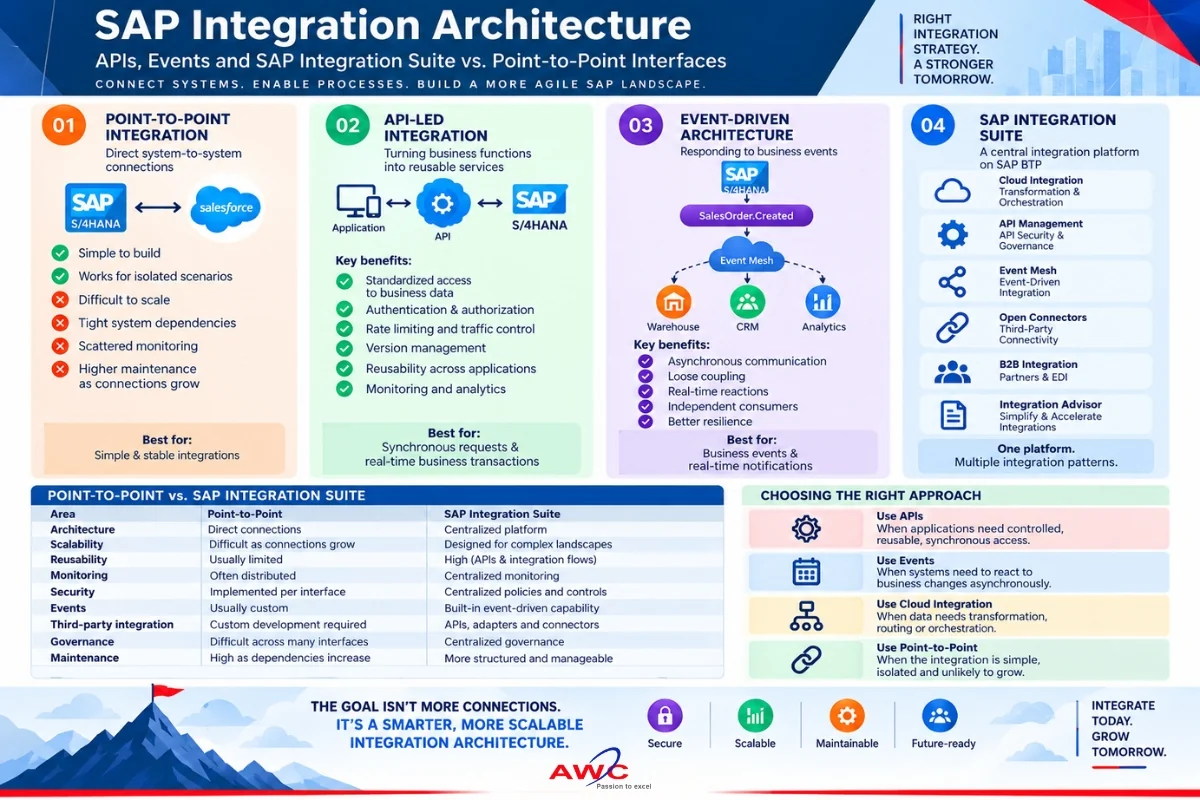
In the modern days, SAP architecture views integration as an advanced architecture feature of a product. Integration involves application programming interfaces, structured information exchanges, events, security policies and procedures, control and management.
Point-to-Point Integration: Simple but Hard to Scale
In a point-to-point setup, two systems talk directly. For example:
SAP S/4HANA → SalesforceA custom interface might pull customer data from SAP. It reshapes the data into the format Salesforce needs. Then it pushes the data across.
This works fine with a handful of systems. It is quick to build. It suits simple, stable needs.
The trouble starts when connections grow. Direct links create tight dependencies between applications. A change on one side can force changes across several interfaces. Monitoring gets scattered too. There is no single place to see the full integration picture.
Over time, this often turns into a mix of custom APIs, IDocs, RFCs, SOAP services, batch jobs, and file transfers. Some teams call this "integration spaghetti."
API-Led Integration: Turning Business Functions into Reusable Services
APIs offer a cleaner way to organize this.
External applications do not need to touch SAP directly. Instead, organizations can expose specific business capabilities through APIs. For example:
GET /customers/{customerId}This adds an abstraction layer. It sits between the consuming application and the SAP backend. Applications no longer poke directly into SAP tables.
Why APIs help:
- Standardized access to business data
- Authentication and authorization built in
- Rate limiting and traffic control
- Version management
- Reusability across applications
- Monitoring and analytics
The API Management feature of SAP Integration Suite allows API development, security, traffic control, publishing, and monitoring. This is appropriate for synchronous communication, which necessitates an instant reply from the app.
For example, an external system submitting a sales order usually needs quick confirmation. It needs to know the transaction went through.
Event-Driven Architecture: Responding to Business Events
Not every integration needs a request-and-response cycle.
Take a sales order created in SAP. Instead of every system checking SAP for updates, SAP can publish an event. It might look like this:
SalesOrder.CreatedOther applications subscribe to that event. They react on their own terms. This is the basis of event-driven architecture, or EDA.
The production system does not need to know who is listening. This loose coupling is what makes event-driven designs flexible.
SAP Event Mesh supports publish/subscribe and point-to-point messaging patterns. It lets applications communicate asynchronously through events.
Events work well for:
- Order creation
- Inventory changes
- Shipment updates
- Customer updates
- Payment status changes
- Workflow triggers
- Real-time notifications
A typical flow might look like this:
SAP S/4HANA → Order Created Event → Event Mesh → Warehouse + CRM + AnalyticsEach consumer processes the event on its own schedule. This makes the system more resilient. It also cuts down on unnecessary synchronous dependencies.
SAP Integration Suite: A Central Integration Platform
SAP Integration Suite brings several capabilities together on SAP Business Technology Platform, or BTP. This includes Cloud Integration, API Management, Event Mesh, Open Connectors, Integration Advisor, and Trading Partner Management.
This matters because most enterprises need more than one pattern:
- APIs for synchronous access
- Events for real-time asynchronous communication
- Cloud Integration for transformation and orchestration
- Open Connectors for third-party connectivity
- B2B capabilities for partner and EDI scenarios
Integration Suite gives teams one platform to build and run all of this. Teams do not need to manage each piece as a separate tool.
SAP Integration Suite vs. Point-to-Point Interfaces
| Area | Point-to-Point | SAP Integration Suite |
|---|---|---|
| Architecture | Direct connections | Centralized integration platform |
| Scalability | Difficult as connections grow | Built for complex landscapes |
| Reusability | Usually limited | APIs and integration flows can be reused |
| Monitoring | Often scattered | Centralized monitoring |
| Security | Handled per interface | Centralized policies and controls |
| Events | Usually custom-built | Event-driven capabilities available |
| Third-party Integration | Often needs custom development | APIs, adapters, and connectors |
| Governance | Hard across many interfaces | Centralized governance |
| Maintenance | Grows heavier with dependencies | More structured and manageable |
Point-to-point integration is not a bad idea by default. It still suits simple, isolated scenarios. The problem starts when teams rely on it as the default for a growing, complex enterprise.
Connecting SAP with Third-Party Enterprise Systems
Typically, SAP integrations interface with other business applications such as Salesforce, ServiceNow, Workday, Microsoft products, e-commerce platforms, shipping companies, and banking systems.
One should begin from the business need rather than technology. If a third-party software requires access to the customer data with no delay, the most suitable option is to use the application programming interface. If there are several software solutions that have to perform in reaction to the customer record being changed, events will suit better. In case data needs transformation, enrichment, routing or orchestration across systems, cloud integration is to be applied.
SAP also offers Open Connectors. These simplify connections to many non-SAP applications. Teams do not need to build everything from scratch.
Security and Governance Cannot Be an Afterthought
Integration architecture shapes how enterprise data stays protected.
APIs need to be governed by appropriate security measures as it relates to authentication and authorization. Data confidentiality should be ensured throughout its transmission and processing. With central control of APIs, security policies can be enforced from a single point. This includes everything from authentication to throttling the API, blocking IP addresses, and API checks.
As far as the legislation that deals with data protection is concerned, the Digital Personal Data Protection Act, 2023 should be noted.
When it comes to the essentials that need to be taken care of when building integration capability, they should include having access control systems, logging system, retention limit, and encapsulation of secure transmission right from the very beginning rather than adding them on top of the system later on.
Choosing the Right SAP Integration Pattern
No single pattern solves every problem. A practical architecture usually combines several:
- Use APIs when applications need controlled, reusable, synchronous access to business data.
- Use events for connecting systems to business changes asynchronously and almost in real-time.
- Use Cloud Integration technology for situations that require message transformation, routing, orchestration, mapping, etc. across different systems.
- Point-to-point integration is only suitable for a simple and standalone integration that would not become part of a complicated integration chain in the future.
The strongest architectures do not mean "API-only" or "event-only." They apply the most suitable technique according to the business interaction.
Building a Future-Ready SAP Integration Architecture
The modern approach to SAP integration needs to be based on the principles of decoupling, reuse, security, observability, and governance.
New demands may not require new custom interfaces. It is better first to find out whether any API, event, connector, or integration process is available for reuse.
SAP Integration Suite enables this approach. It enables you to consolidate application integration, API management, event-based integration, and connectivity.
The point of merging systems is not to connect as many systems as possible. The aim is to ensure that your architecture allows systems to function independently while at the same time your business processes are executed reliably. This is the main difference between past and current approaches to integration.
Frequently Asked Questions
What is SAP Integration Suite?
SAP Integration Suite is an integration service that works as the network of SAP services over SAP BTP. It enables B2B integration through application integration, API management solutions, event-driven approaches, and third-party connectors, among other capabilities.
Is point-to-point integration still useful?
Yes. It works well for simple, isolated connections with limited dependencies. It becomes hard to maintain as a landscape grows and changes.
What is the difference between API-led and event-driven integration?
API-led integration lets applications request data or invoke business functions directly. Event-driven integration lets systems publish and consume notifications about business changes asynchronously.
What is the role of Event Mesh in SAP integration?
Event Mesh lets applications communicate through business events. It supports asynchronous, publish/subscribe patterns that create loosely coupled architectures.
Can SAP Integration Suite connect SAP and non-SAP applications?
Yes. It is built for hybrid landscapes. It supports connectivity with third-party applications through integration flows, APIs, adapters, events, and connectors.
Should companies completely eliminate point-to-point interfaces?
Not quite. A wiser route is to establish architectural standards and employ point-to-point connections where appropriate. More complex and larger cases should require the use of reusable APIs, centralized solutions, and event-driven technologies.
Tags: SAP Integration Suite, API Management, Event Mesh, SAP BTP, Integration Architecture